Qi Energy
Qi is the energy that pervades all nature. It is generally thought that it originates from the Sun and is conducted through the environment, purifying as it goes in a circle back to the Sun, increasing in speed and as it does so. Experiments designed to prove its existance and gain hard evidence generally fail, as it seems, the harder someone tries for definate proof, the more evasive is nature. However we have a natural awareness for it, which can be developed, and its conduction through the human body is responsible for how we feel. Obstructions of energy cause illness as does low energy. Virtually all energetic healing arts aim at removing obstructions and allowing the Qi to flow. It is the internal circulation of energy that makes us flexible, adaptive and resilient to illnessess.

Yin- Yang and the Five Elements
The theory of Yin-Yang explains the balance under which life is supported. The theory of the Five elements explains the qualities of, and the interdependence of organs in the human body. Both of these theories explain the use of subtle energy-Qi to crystallize life in a physical functioning form, in a universe where science says everything tends to a state of maximum disorder. Qi has an ordering, nourishing and cleansing effect, internally, and a protective effect externally.
These patterns that have been observed internally, often have similarities in nature, as nature is also alive. So just as it is important to live in a clean environment for health, it is also important to be aware of the internal balances so that a person is flexible and imbalances are minimised.
Yin Yang
The theory of Yin-Yang holds that every object or phenomenon in the universe contains an amount of two opposite aspects, namely, Yin and Yang, which oppose each other and are in a mutual interdependence. Further- this relation between Yin and Yang is the universal law of the material world, the principle and source of the existence of myriad of things, and the root cause for the flourishing and perishing of things.
The relationships between Yin and yang are extensively used in traditional medicine to explain the physiology and pathology of the human body and serve as a guide to diagnose and treatment in clinical work.
The theory of Yin-Yang explains the balance under which life is supported. The theory of the Five elements explains the qualities of, and the interdependence of organs in the human body. Both of these theories explain the use of subtle energy-Qi to crystallize life in a physical functioning form, in a universe where science says everything tends to a state of maximum disorder. Qi has an ordering, nourishing and cleansing effect, internally, and a protective effect externally.
These patterns that have been observed internally, often have similarities in nature, as nature is also alive. So just as it is important to live in a clean environment for health, it is also important to be aware of the internal balances so that a person is flexible and imbalances are minimised.
Yin Yang
The theory of Yin-Yang holds that every object or phenomenon in the universe contains an amount of two opposite aspects, namely, Yin and Yang, which oppose each other and are in a mutual interdependence. Further- this relation between Yin and Yang is the universal law of the material world, the principle and source of the existence of myriad of things, and the root cause for the flourishing and perishing of things.
The relationships between Yin and yang are extensively used in traditional medicine to explain the physiology and pathology of the human body and serve as a guide to diagnose and treatment in clinical work.
Qualities of Yin and Yang
| |
Yin
|
Yang
|
Coldness
|
Hotness
|
Downward
|
Upward
|
Dimness
|
Brightness
|
Inactivity
|
Activity
|
Nourishing
|
Protective
|
Interior
|
Exterior
|
Sun (remember the Sun nourishes the Earth)
|
Moon (remember the Moon is the most active since it is orbiting around Earth)
|
Yang and Yin are relative
The tissues and organs of the human body may pertain either to Yin and yang according to their relative locations and functions. Viewing the body as a whole, the trunk surface and the four extremities, being on the exterior, pertain to Yang, while the Zang-Fu organs are inside the body and are relatively speaking Yin.
Viewing the body surface and the four extremities along, the back pertains to Yang, while the chest and abdomen pertain to Yin.
The lateral aspect of the four extremities pertains to Yang and the medial aspect to Yin.
The channels running along the lateral aspect of an extremity pertain to Yang and the medial aspect to Yin.
When speaking of the Interior –Exterior (Zang-Fu) organs alone, the Exterior (Fu) organs with their main function of transmitting and digesting food pertain to Yang, while the Interior (Zang) organs with their main function of storing vital essence and vital energy pertain to Yin. Each of the Zang-Fu organs itself can again be divided into Yin or Yang. Eg the Yin and Yang of the Kidney, the Ying and Yang of the Stomach etc.
In short, however complex the tissues and structures of the human body, and their functional activity, they can be generalized and explained by the relation of Yin and Yang.
In an excess of Yin, there is too much cooling occurring from low activity and the result is cold symptoms. If there is an excess of Yang there is too much heating and activity, so hot signs will be evident. When there is an empty condition the patient needs to be tonified (energy increased). In a full conditions the patient needs to be sedated (energy drained). It can be seen that in all treatments the method is to return the Yin Yang and Empty Full balance to normal.
For instance, an acute high fever at the beginning of a Flu is a Full Yang condition, and the treatment is aimed at draining the heat. In the case of a chronic afternoon fever and restlessness, this is still a preponderance of Yang, however is an Empty condition because Yin has been exhausted, and is usually called an Empty Yin condition.
5 Cycles
Nourishing cycle (Sheng)
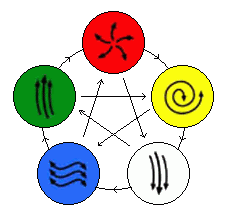
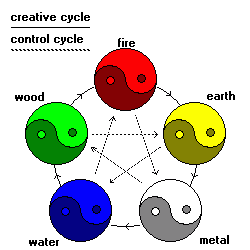
Nourishing implies promoting growth. The order of nourishing is that Wood promotes Fire, Fire nourishes Earth, Earth nourishes Metal, Metal nourished water, and Water in turn nourishes Wood.
When considering one element, it is considered to the “mother” of the next one, and the “son” of the previous one. Hence the nourishing cycle- each nourishes the next.
Using this cycle, if one element is empty, the previous one can be stimulated to nourish the empty one.
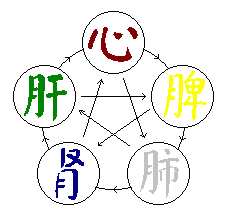
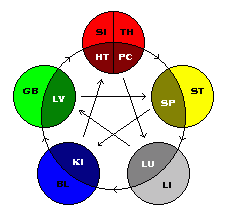
Disharmonies of this cycle are empty conditions. For example if the Fire element is empty, Wood element can be stimulated to nourish the Fire. The Fire element corresponds to Heart and Wood to the Liver. So for Heart problems such as restlessness and insomnia the Liver may be treated.
Controlling cycle (Ke)
This is a restraining cycle. In the interacting relation of the five elements, the order is that wood acts on Earth, Earth acts on Water, Water acts on Fire, Fire acts on Metal, and Metal in turn acts on Wood.
Disharmonies of this cycle are full conditions and take the form of
The tissues and organs of the human body may pertain either to Yin and yang according to their relative locations and functions. Viewing the body as a whole, the trunk surface and the four extremities, being on the exterior, pertain to Yang, while the Zang-Fu organs are inside the body and are relatively speaking Yin.
Viewing the body surface and the four extremities along, the back pertains to Yang, while the chest and abdomen pertain to Yin.
The lateral aspect of the four extremities pertains to Yang and the medial aspect to Yin.
The channels running along the lateral aspect of an extremity pertain to Yang and the medial aspect to Yin.
When speaking of the Interior –Exterior (Zang-Fu) organs alone, the Exterior (Fu) organs with their main function of transmitting and digesting food pertain to Yang, while the Interior (Zang) organs with their main function of storing vital essence and vital energy pertain to Yin. Each of the Zang-Fu organs itself can again be divided into Yin or Yang. Eg the Yin and Yang of the Kidney, the Ying and Yang of the Stomach etc.
In short, however complex the tissues and structures of the human body, and their functional activity, they can be generalized and explained by the relation of Yin and Yang.
In an excess of Yin, there is too much cooling occurring from low activity and the result is cold symptoms. If there is an excess of Yang there is too much heating and activity, so hot signs will be evident. When there is an empty condition the patient needs to be tonified (energy increased). In a full conditions the patient needs to be sedated (energy drained). It can be seen that in all treatments the method is to return the Yin Yang and Empty Full balance to normal.
For instance, an acute high fever at the beginning of a Flu is a Full Yang condition, and the treatment is aimed at draining the heat. In the case of a chronic afternoon fever and restlessness, this is still a preponderance of Yang, however is an Empty condition because Yin has been exhausted, and is usually called an Empty Yin condition.
5 Cycles
Nourishing cycle (Sheng)
Nourishing implies promoting growth. The order of nourishing is that Wood promotes Fire, Fire nourishes Earth, Earth nourishes Metal, Metal nourished water, and Water in turn nourishes Wood.
When considering one element, it is considered to the “mother” of the next one, and the “son” of the previous one. Hence the nourishing cycle- each nourishes the next.
Using this cycle, if one element is empty, the previous one can be stimulated to nourish the empty one.
Disharmonies of this cycle are empty conditions. For example if the Fire element is empty, Wood element can be stimulated to nourish the Fire. The Fire element corresponds to Heart and Wood to the Liver. So for Heart problems such as restlessness and insomnia the Liver may be treated.
Controlling cycle (Ke)
This is a restraining cycle. In the interacting relation of the five elements, the order is that wood acts on Earth, Earth acts on Water, Water acts on Fire, Fire acts on Metal, and Metal in turn acts on Wood.
Disharmonies of this cycle are full conditions and take the form of
overacting. For instance, Wood can overdominate Earth. In terms of organs, the Liver can overdominate the Spleen leading to digestive function being impaired.
In this way each of the five Elements occupies the position of “being acted on” ( nourished) and “acting on” (controlling).
Offending cycle (Wu)
This is the reverse of the controlling cycle and is a destructive cycle. When it occurs it causes a disharmony. For instance Wood can rise up against Metal. The organs this corresponds to is the Liver striking upwards affecting the Lungs.
In this way each of the five Elements occupies the position of “being acted on” ( nourished) and “acting on” (controlling).
Offending cycle (Wu)
This is the reverse of the controlling cycle and is a destructive cycle. When it occurs it causes a disharmony. For instance Wood can rise up against Metal. The organs this corresponds to is the Liver striking upwards affecting the Lungs.
.jpg)